
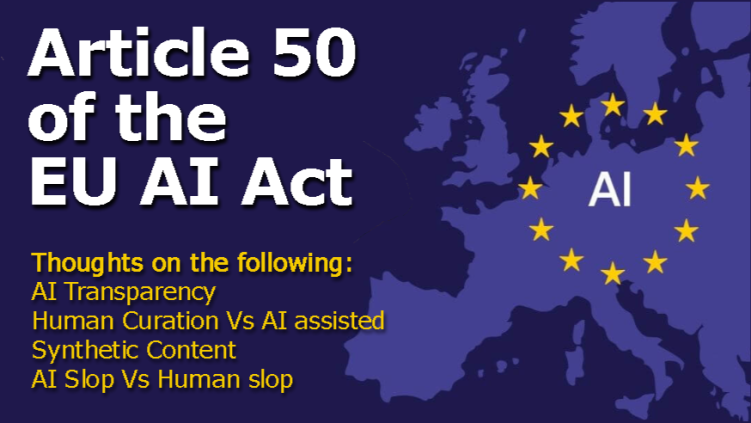
Article 50 of the EU AI Act isn’t a suggestion, it is a binding, mechanical mandate. It tells everyone to “do as they are told.” But when you look at how it actually applies across media, the disconnect between bureaucratic theory and operational reality becomes glaring.
Article 50, The Poll, and The Watermark on the Slop Engine
There was a poll on LinkedIn. The question was simple enough:
“Claude is adding a watermark to AI text. Should AI-generated content be identifiable by default?”
- 👍 Yes. Better transparency
- 👎 No. Judge the content
- 🤔 Only with disclosure
- 🔐 Yes. Provenance matters
The funny thing about the poll is that as a binary choice, but the answer isn’t binary. As paradoxically, every single option can correct depending on where you stand.
Why?
- Provenance matters when you are verifying deepfakes, legal filings, or state-sponsored disinformation.
- Transparency matters when a digital transformation client needs to know if software documentation was hallucinatory or audited.
- Disclosure matters in social discourse to separate honest co-creation from lazy deception.
- Judge the content matters when a human writer uses a tool to polish syntax, fix typos, or bounce ideas off a wall.
While we debate the philosophy of polls, the law has already decided for us. Article 50 of the EU AI Act has arrived, and its message is blunt: Do as you are told.
But what does Article 50 Actually say?
Under Article 50, providers and deployers of AI systems face strict transparency obligations across all media formats:
- Text: Synthetic text published to inform the public on matters of public interest must be disclosed as artificially generated or manipulated, unless it has undergone human editorial review and a natural person holds legal responsibility.
- Images & Audio/Video (Deepfakes): Any artificial or manipulated content that significantly resembles real people, places, or events must be prominently labelled as artificially created or altered.
- Machine-Readable Provenance: AI generators must mark their outputs in a technical, machine-readable format (such as C2PA metadata) so downstream platforms can detect them automatically.
On paper, this sounds like clean, sensible regulation. In practice, it creates a bizarre double standard across our media ecosystem and the desire for LinkedIn to reduce the amount of ‘AI slop’ that is presented through the platform
The Christmas 1996 Test
Back in Christmas 1996, I designed a double-page spread for a regional daily newspaper summarizing the “Quotes of the Year.”
I didn’t utter a single one of those quotes. A sub-editor gathered them from news wires, and I spent a few hours arranging the typography, balancing white space, and building a visual hierarchy.
The raw material belonged to the newsroom, but the structure, assembly, and presentation belonged to me. Nobody demanded a watermark saying “This page contains 0% original speech.” We understood that human craft lives in orchestration, curation, and final editorial judgment.
Fast forward to 2026. If a digital consultant uses an LLM to help structure a complex 2,000-word essay drawn from 30 years of career history, compliance hawks demand a watermark. Fair enough
Meanwhile…
What does the LinkedIn platform algorithm actually amplify?
Search LinkedIn today and you will find dozens of accounts posting the exact same graphic of a CV, complete with hallucinated LLM typos (“finescial,” “meusu”), claiming a “98% ATS score.”
It is literal machine slop, posted by humans acting like low-level spammers to sell fake resume rewrites to desperate job seekers. (And that’s just one of the many types of ‘slop’ that we all experience.)
So what we find is the following
- Compliance Ideal = Demands watermarks on human-edited, highly polished prose.
- Platform Reality = Pushes un-watermarked, copy-pasted, hallucinated scam templates.
Do as you are told
Article 50 will force platforms to tag synthetic media at the model layer. Machine-readable metadata will be baked into pixel buffers and text streams. And that is fine. Compliance is a spec. We will follow the rules.
But a technical watermark on an output file will never replace human editorial judgment. It won’t stop engagement farms from exploiting job seekers, and it won’t tell you whether an essay was born from genuine reflection – like sitting on a hot rail-replacement bus to Aberystwyth during a solar eclipse – or generated by a prompt-dump.
So, go ahead and mandate the tags. Label the files. Follow Article 50.
Because when the watermarks are applied to everything, readers will eventually have to do what they should have been doing all along: Stop auditing the ink, read the page, and judge the content.
This essay blends intentional human curation with AI‑assisted support; all synthetic content is intentionally disclosed.
First: LinkedIn August 17, 2026
Leave a Reply